What if the wallet in your browser did more than hold keys — what if it simulated, scanned and let you revoke permissions before a single signature? That claim reframes the simple act of “installing a wallet” into an operational security decision: you’re choosing a set of trade-offs between convenience, visibility, and the limits of automated defenses. For DeFi power users — traders, liquidity providers, and contract-interacting bots operating from the U.S. digital finance landscape — understanding how Rabby works changes the checklist you run before any on-chain move.
This explainer walks through the mechanics of installing Rabby as a Chrome-compatible extension, the defensive features that matter for heavy DeFi use, where those features stop short, and practical heuristics for deciding when Rabby is the right tool in your stack. Along the way I note real limits (including past incident response) and actionable steps you can take after installation to preserve operational security.
How Rabby installs and integrates into a Chromium browser
Installation is intentionally straightforward because the UX hurdle is parallax to user security: a smoother install brings more users, but also more responsibility to maintain trustworthy distribution channels. Rabby is distributed as a browser extension for Chromium-based browsers — Chrome, Brave, and Edge — and the recommended pattern for DeFi power users is:
– Confirm source: install only from verified extension stores or the project’s canonical distribution page. Doubles-check the extension ID and publisher.
– Seed or hardware: during setup you can create a new seed phrase, import an existing seed, or connect a hardware wallet. For US-based professional users, pairing Rabby with a hardware signer (Ledger, Trezor, Keystone, etc.) and, when applicable, a multi-sig backend (Gnosis Safe, Fireblocks) is a prudent baseline.
– Permissions and defaults: Rabby offers a ‘Flip’ toggle to set it as your default wallet instead of MetaMask, and it will request access to sites when you interact with dApps. Consider keeping automatic site access confined to a curated list; the fewer pages that can prompt signatures, the lower the accidental exposure.
Mechanisms that differentiate Rabby for DeFi power use
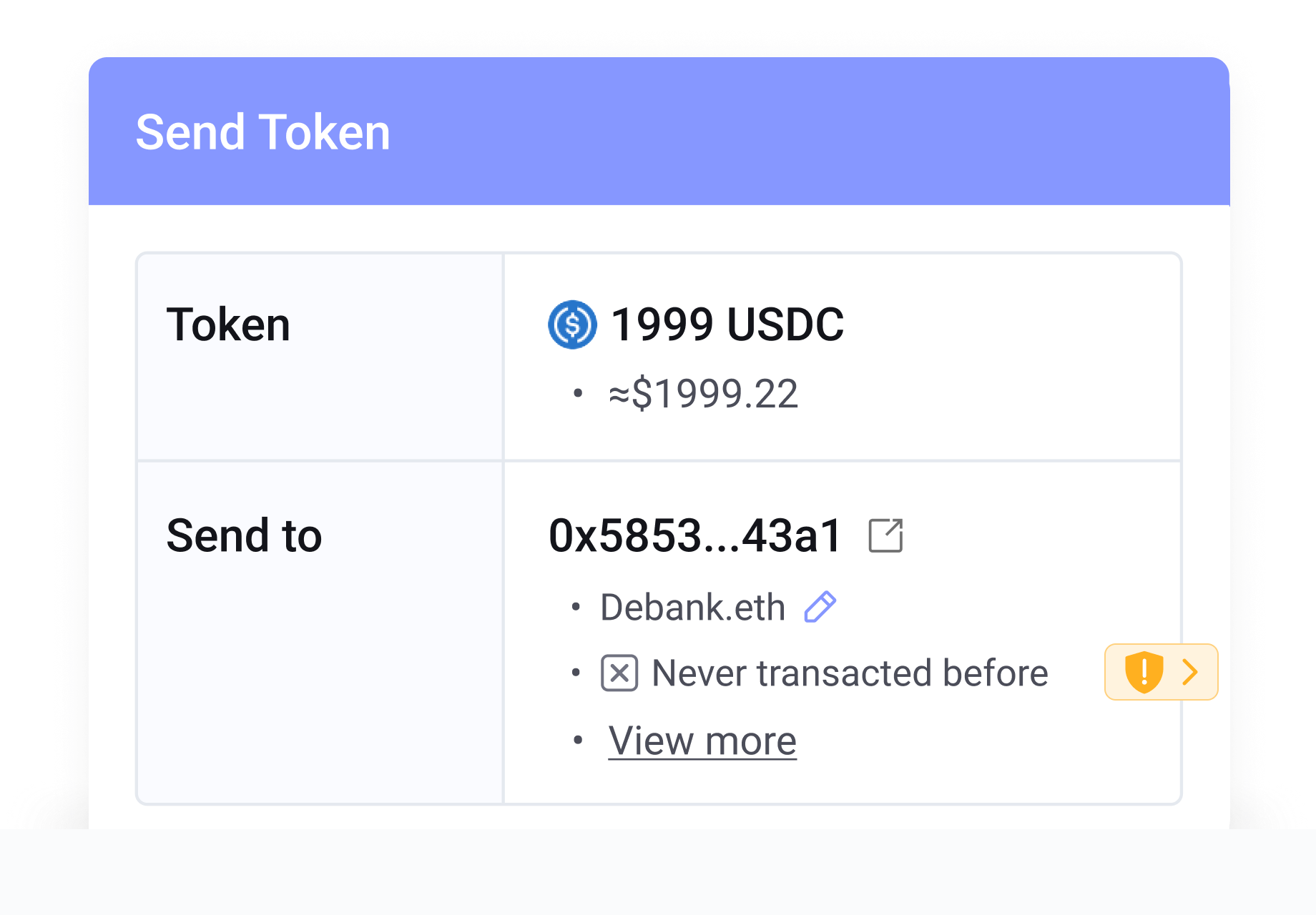
Rabby’s real contribution is in three linked mechanisms: pre-transaction risk scanning, transaction simulation, and approval revocation. Mechanism-first: before you sign, Rabby runs a simulation of the transaction on the target chain and a security engine checks the contract and the method being called. The UI surfaces estimated balance changes, the expected gas fees, and flags like previously compromised contracts or suspicious approval requests. That combination addresses the common failure mode of ‘blind signing’ — approving actions without understanding balance impacts.
Two practical implications follow. First, simulated balance outputs give you deterministic expectations for net asset movement; that helps catch simple logic errors in contract calls or malicious router addresses. Second, the approval revocation tool reduces long-lived ERC-20 approvals, which are a frequent source of large-scale drains when a dApp or indexer is compromised. Together these features change the decision problem from reactive recovery to proactive removal of attack surfaces.
Rabby also automates network switching: it detects which EVM chain a dApp requires and switches your wallet for you. For traders straddling Ethereum mainnet, Arbitrum, Optimism, Polygon and dozens of other EVM chains (Rabby supports 90+), this reduces user error during cross-chain activity. Additionally, the cross-chain gas top-up mechanism helps when you need gas on a secondary chain without a separate on-ramp transaction.
Where Rabby helps — and where it doesn’t
Be precise about the boundary conditions. Rabby’s preventative features matter most against social-engineering, accidental contract interactions, and common classes of automated exploits that rely on user-approved allowances. They do not, however, make you immune to every class of compromise. If your host machine is infected, or if you expose your seed phrase to a phishing page, Rabby’s simulations and scans cannot recover keys or undo a signature given under duress.
Another clear limitation is that Rabby lacks a native fiat on-ramp and does not provide native in-wallet staking. For U.S. users who rely on on-ramps tied to KYCed custodians, this means an external custody or exchange step remains necessary. Also remember the historical incident: in 2022 a smart contract linked to Rabby Swap was exploited for roughly $190,000. The team froze the contract and compensated users, and the incident underscores a key point: extensions and their auxiliary contracts expand the attack surface. Open-source helps with auditability, but it does not guarantee correctness.
Finally, while Rabby integrates with hardware wallets and institutional signers, the protection guarantees depend on how the entire signing flow is assembled. Using Rabby as a UI with a hardware signer layered underneath preserves the strongest threat model against remote attackers: even if an extension is compromised, hardware signature confirmation can block arbitrary transactions — provided the device’s firmware and host remain secure.
Decision framework: when to use Rabby versus alternatives
For a power user building a secure, efficient multi-chain workflow, here are three heuristics to guide whether Rabby is the right primary interface:
1) If you interact with many dApps across multiple EVM chains and value automatic network switching plus balance-level simulations, Rabby materially reduces operational friction and cognitive load.
2) If your workflow depends on long-lived approvals (e.g., automated market makers or aggregator bots), Rabby’s revocation tools and approval visibility should be part of a periodic audit routine.
For more information, visit rabby wallet extension.
3) If you must onboard fiat, or require native staking flows within the wallet UI, Rabby’s current lack of in-wallet fiat on-ramp and staking means you’ll need complementary tools (exchange accounts, staking dashboards) — Rabby won’t replace them.
These heuristics are not mutually exclusive. Many U.S.-based DeFi users will find Rabby best used in combination: as the browser extension UI for day-to-day interactions, paired with hardware signers for key material and institutional multi-sig for high-value custody.
Operational checklist after installation
Immediately after installing the extension, run this checklist to operationalize Rabby’s protections:
– Connect a hardware wallet or configure multi-sig where possible; avoid seed phrase import on desktops used for high-value positions.
– Run a dry swap on a small amount and examine the transaction simulation output: confirm you can read the estimated balance changes and gas line items.
– Use the approval manager to find and revoke unnecessary allowances; treat approvals as time-limited by design.
– Configure site access and turn off broad “always allow” settings; prefer ephemeral site permissions when interacting with new dApps.
– Keep the extension updated and monitor release notes; open-source code is audit-friendly, but fixes require active deployment and user updates.
FAQ
Is Rabby safer than MetaMask for heavy DeFi interaction?
Safer is conditional. Rabby reduces certain risks (blind signing, hidden approvals, accidental network mistakes) through transaction simulation and revocation tools. MetaMask remains widely used and integrated; its risk profile differs. The practical rule: pair Rabby with a hardware wallet and treated approvals as revocable to get the meaningful safety gains.
Can I import my existing wallet into Rabby?
Yes. Rabby supports importing wallets via seed phrase or private key and also allows toggling between Rabby and MetaMask as your default extension. For high-security setups in the U.S., prefer hardware wallet connections over seed imports on browser hosts.
Does Rabby let me buy crypto with USD directly?
No. Rabby currently lacks a built-in fiat on-ramp. You will need to use an exchange or third-party service to convert USD to crypto and then transfer tokens to your Rabby-controlled address.
How does transaction simulation work and what are its limits?
Simulation replays the transaction on a node or a stateless emulator to estimate token balance changes and gas. It catches logical outcomes and known bad addresses, but it can’t predict all off-chain oracle behaviors or future on-chain state changes between simulation and final inclusion. Simulations are a strong guardrail, not an absolute guarantee.
What to watch next — indicators that should change your setup
For the tactical DeFi user, monitor three signals: new categories of contract exploits that bypass front-end simulations (for example, flash-loan attacks that manipulate oracle prices between simulation and execution), major releases or breaking changes in Rabby’s extension updates, and regulatory changes in the U.S. that affect how on-ramps, custody, or institutional integrations operate. If Rabby expands native fiat or staking features, re-evaluate whether you can consolidate workflows; if not, continue using complementary services.
Finally, if you want to try Rabby in your browser after reading this, the project provides a browser extension that emphasizes simulation and approvals management; you can find the installation and distribution details at the rabby wallet extension. Treat installation as the start of a security posture, not the end: tools help, but disciplined procedures and layered defenses make them effective.